The €10 Eco Tax: Stop Debating, Start Earning It
Altu · 3 November 2026 · 8 min read
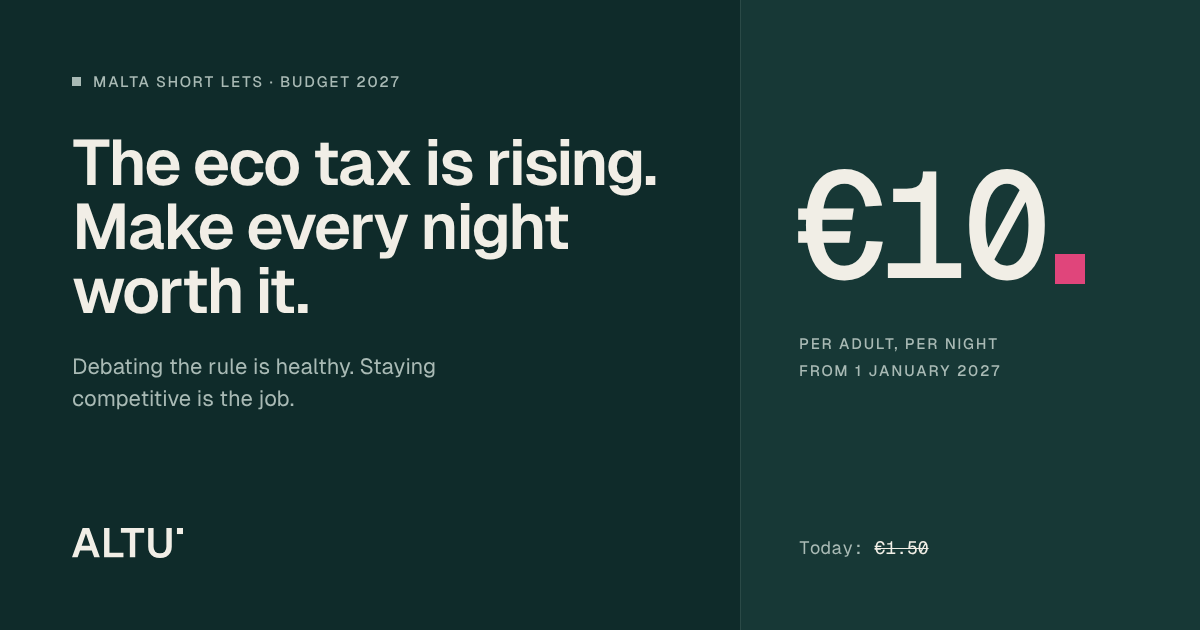
From 1 January 2027, every adult guest in a Maltese short let will pay a €10 eco-contribution for each night they stay. That is almost seven times today's €1.50, and none of it lands in the property owner's pocket.
If you own or manage a short let, the obvious question is: what now? My answer is simple. The tax is coming, so our job is to make every night feel worth the extra €10.
What actually changes.
The new rates were announced by Finance Minister Clyde Caruana in the Budget 2027 speech on 26 October 2026. They apply to guests aged 18 and over, charged per person, not per booking.
| Accommodation | Until 31 Dec 2026 | From 1 Jan 2027 | Cap per person per stay |
|---|---|---|---|
| Short lets (Airbnb, Booking.com, direct) | €1.50 / night | €10 / night | €80 (reached after 8 nights) |
| Hotels, guesthouses, collective accommodation | €1.50 / night | €8 / night | €64 |
A few points worth knowing:
- Short-let guests pay €2 more per night than hotel guests, so up to €16 more per person per stay once both caps are hit.
- The €1.50 rate itself only started on 1 July 2026, when it replaced €0.50. Until the legal notice for the new rates is published, €1.50 (capped at €22.50) is what's in force.
- Government expects the accommodation changes to raise about €182 million a year. A separate €10 charge applies to cruise passengers who visit and re-board the same ship.
- The stated reasons: investment in tourism infrastructure, and the fact that visitors benefit from Malta's energy subsidies. Malta is heading for more than 4.5 million tourists and roughly 28 million guest nights this year.
The point that stings for owners: this is collected from the guest and paid over to the MTA. It is not revenue for the property.
What your guest will see on the bill.
| Stay | Eco-contribution at €1.50 | Eco-contribution at €10 | Extra cost |
|---|---|---|---|
| Couple, 3 nights | €9 | €60 | €51 |
| Couple, 7 nights | €21 | €140 | €119 |
| Family of 2 adults + 2 kids, 7 nights | €21 | €140 | €119 |
| Solo traveller, 10 nights | €15 | €80 (capped) | €65 |
For a couple on a week's holiday, that is €119 more than they'd have paid this summer. It's not the end of the world, but it's real money and it will be on their mind when they compare your apartment against a hotel down the road.
Debate is healthy. Speculation isn't.
I have no problem with people questioning this rule. Is a €2 gap between short lets and hotels fair? Where exactly will €182 million a year be spent? Those are good questions and the industry should keep asking them.
What doesn't help is speculation. "Tourists will stop coming." "Airbnb in Malta is finished." "They'll scrap it after the first summer." None of us knows that and building a business plan around a guess is how you lose a season.
Here's what we do know: the rates are announced, the revenue is already earmarked in the budget, and government looks fully committed to the strategy. I'd rather spend my energy staying competitive within the rules than hoping to change a decision that has already been made.
The real challenge: be worth €10 more a night.
The guest doesn't care where the €10 goes. They care whether the stay felt worth the total they paid. So the question for every owner and manager is the same: what does a guest get from us that makes the extra €10 feel like nothing?
This is how we're approaching it:
- Be upfront about the total. Show the eco-contribution clearly before booking. Surprises at check-in hurt reviews far more than the charge itself.
- Raise the floor on the basics. Spotless cleaning, quality linen, fast Wi-Fi, a coffee machine that works. These are no longer nice extras; they are the price of entry.
- Add small things that feel generous. A welcome pack with local products, a fridge stocked for the first morning, beach towels and a cool bag. Low cost to us, high value to a guest.
- Be the local expert. A proper guide to the area: where to swim, where to eat, how to get to Valletta without a car. A hotel concierge can't match a host who actually lives here.
- Respond fast and fix things faster. Guests forgive almost anything if it's handled within the hour.
- Reward longer stays. With the cap at 8 nights, a 10- or 14-night guest pays no more eco-tax than an 8-night one. Weekly discounts now go further.
None of this is new. The €10 just makes it urgent.
Compete, don't complain.
The eco-contribution is a cost every short let in Malta will carry equally from January. That means it isn't really what separates you from the competition. What separates you is the experience you deliver for the price.
Keep the debate alive, by all means - but don't wait for a change in policy that may never come. Put the work into your property now, and 2027 can still be a strong year.
If you own a property in Malta and want to talk through how to stay competitive under the new rates, get in touch with us at Altu.
Sources: Lovin Malta, Budget 2027 short-let eco-tax · MaltaToday, Budget 2027 tourist tax revenue · KPMG Malta Budget 2027 highlights · MTCA explanatory notes, 2026 eco-contribution changes · Landlord.care, Malta eco contribution 2027
Need a local manager?
We manage short-let and long-let properties across Malta for owners anywhere in the world. Free consultation, no commitment.
WhatsApp us